|
Peoples' movements and protests |
 |
|
Mobilizations19th century women's movementsThe early 20th century workers' movementsChina's women's movementLate 20th century feminismBack to Women's movementsBack to main page |
19th century women’s movement
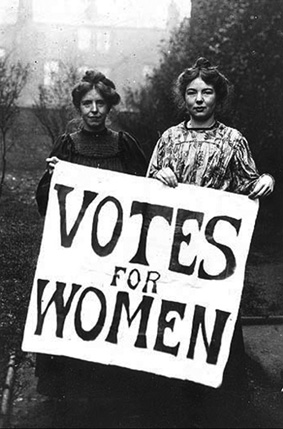
Since the 18th century, women had been prominent popular movement organizers in such a way that they were behind bread revolts when food prices rose above reasonable levels. In this way they had been active participants in the French Revolution and the English Chartist movement<LÄNK>. But this tradition was not intended to assert the interests of women vis-à-vis the patriarchy, but of the family and the local community vis-à-vis the state and capital. The tradition was stifled after about 1850 when women were driven out of the core areas of industry and into peripheral service activities. Instead, it was the middle-class women who first asserted the interests of women as women. More specifically, the Christian revival tradition from the beginning of the 19th century, where women in pursuit of moral perfection became involved in charity. Through this, they acquired a habit of public action that made it absurd that they would not have the same rights as men. The first political activity they participated in was the fight against slavery, mainly in the United States, where women participated in financing, agitation and active liberation of slaves. As they were opposed by traditionalists within the movement, they began to increasingly link women's incapacity with slaves. After the end of slavery in 1863, a large part began to get involved in women’s rights. Others instead organized a movement for temperance, which at the same time took a stand for women’s equal rights. But at the same time, they perceived society’s gender division of labor as self-evident. The same tradition also existed in England. There were no slaves, but the first mobilization was in the 1870s against prostitution. Sobriety was also an important theme there. In both countries, property rights and the right to work and education had first been the main themes, but by the turn of the century 1900 they were all summarized in suffrage as the focus, and a militant struggle for suffrage, with demonstrations and occupations, was waged in the United States and Britain. At the same time, the female working-class tradition began to come to the surface again with a base in the textile industry – and in the country that tradition was strongest, Italy, in agriculture. This as part of the organization of the non-skilled workers in general. The collaboration between these two traditions was not easy. Working women could often perceive the moralism and paternalism of middle-class women as rather troublesome. But many of the latter still helped to organize unions in women-organized industries. After the suffrage struggle was won in several Western European countries, as part of the co-optation of popular movements after the First World War, the women’s movement split another way – between those who demanded equality between men and women and those who demanded more public welfare without gender roles. The latter were in the clear majority in the women’s movement until 1970.
Reading
|